 Manual
Manual · The book
Building & shipping
Test and release builds, signing, notarization — and the licence.
Building takes seconds, because there is no compiler in it: an application is Neuridion's precompiled shell plus your project as an encrypted payload. A bug we fix in the runtime is fixed in every application you rebuild.
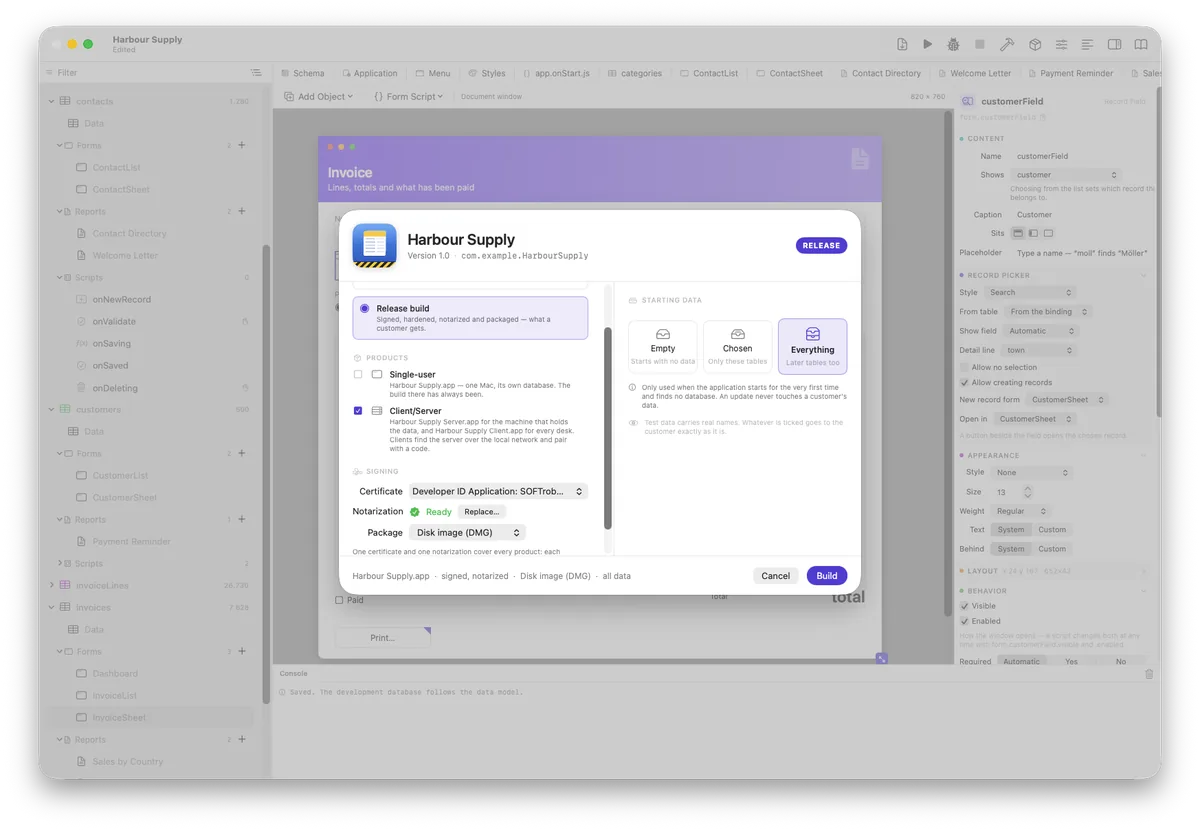
Test build, release build
A test build is quick and unsigned — it runs on your Mac (and on any Mac whose owner right-clicks once, which is why it needs a licence exactly like a release). A release build is signed with your Developer ID, hardened, notarized by Apple and packaged — what a customer gets. The Apple half needs Apple's Developer Program (about 99 € a year, paid to Apple); Neuridion finds your certificate and notarization profile itself and says plainly when they are missing.
Products
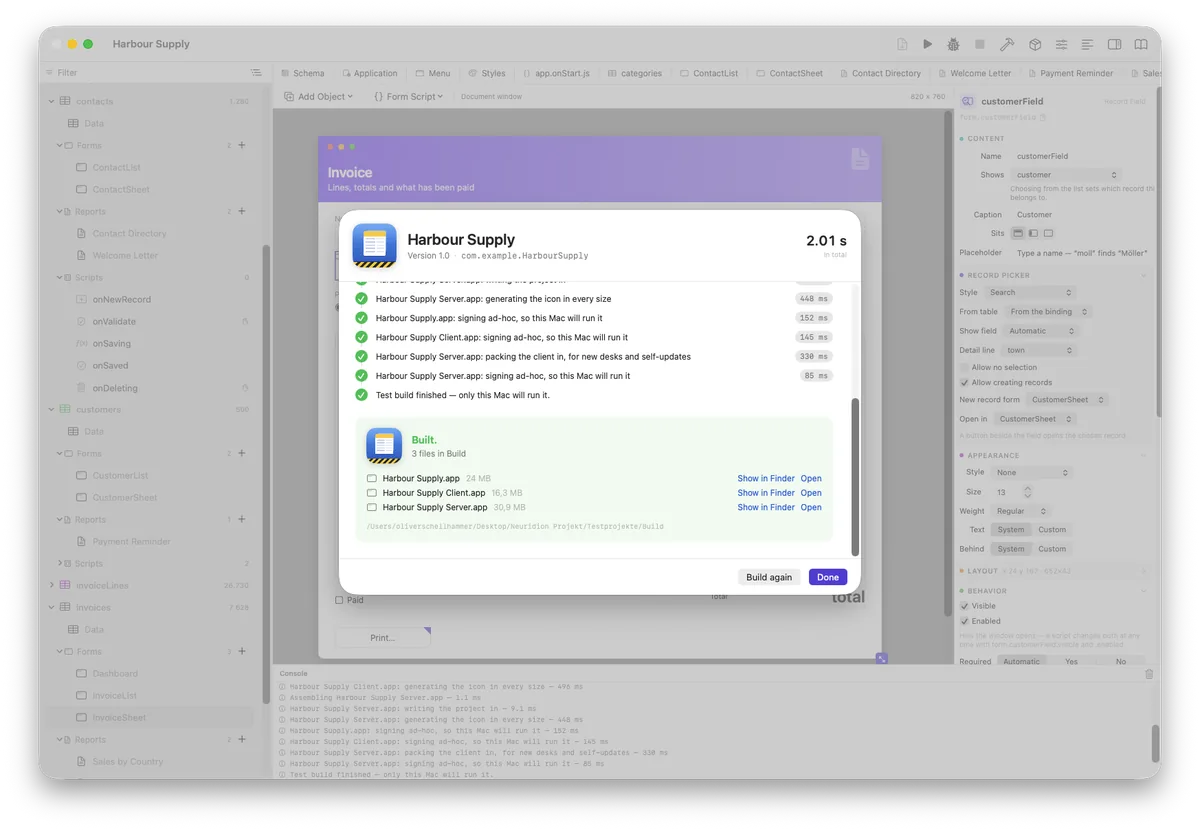
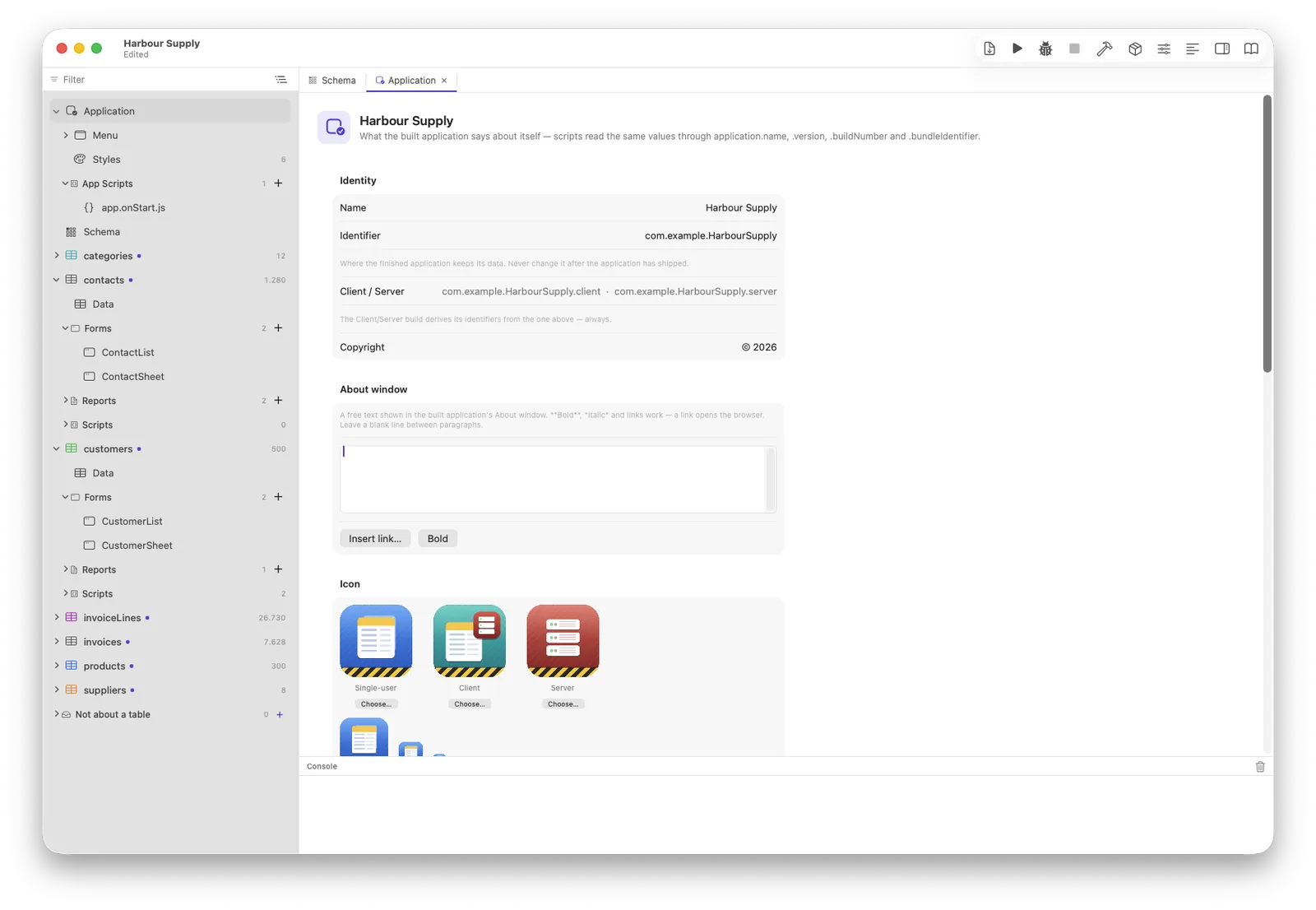
One build can produce up to three applications: Single-user, and — with Neuridion PRO — the Client/Server pair. Each product wears its own icon (three wells in the Application tab; the standard icons are drawn as a family), each is notarized on its own, and the server carries the signed client inside itself for new desks and self-updates.
What comes out
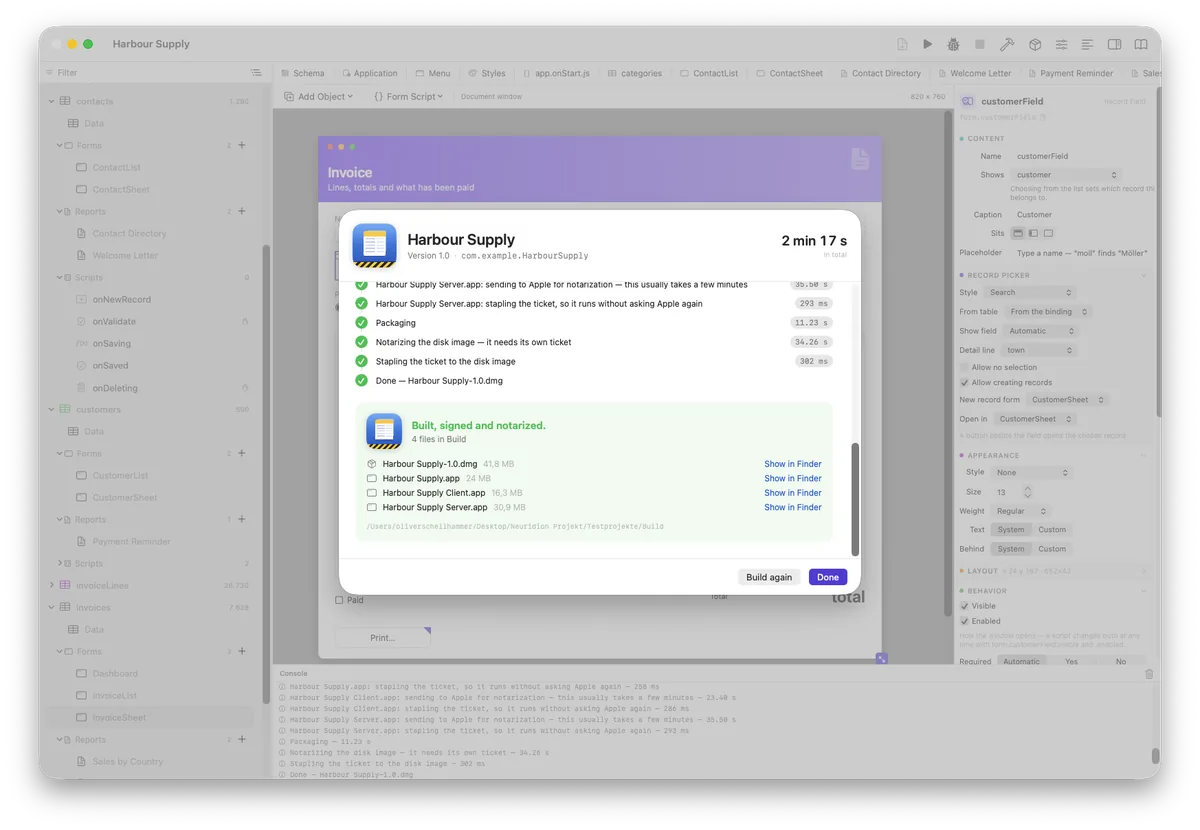
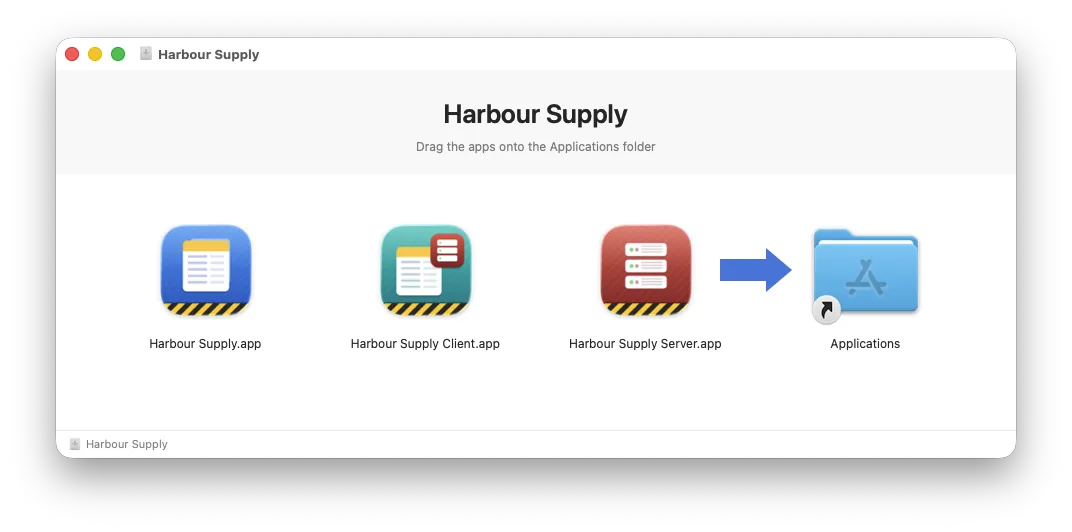
Just the applications, a zip, or a disk image — the one a customer expects: a window with the icons in it and an arrow to the Applications folder. It is drawn by us, not by a template, and a Client/Server build puts all three products in the same window.
The application itself — its menu, its About, its icon
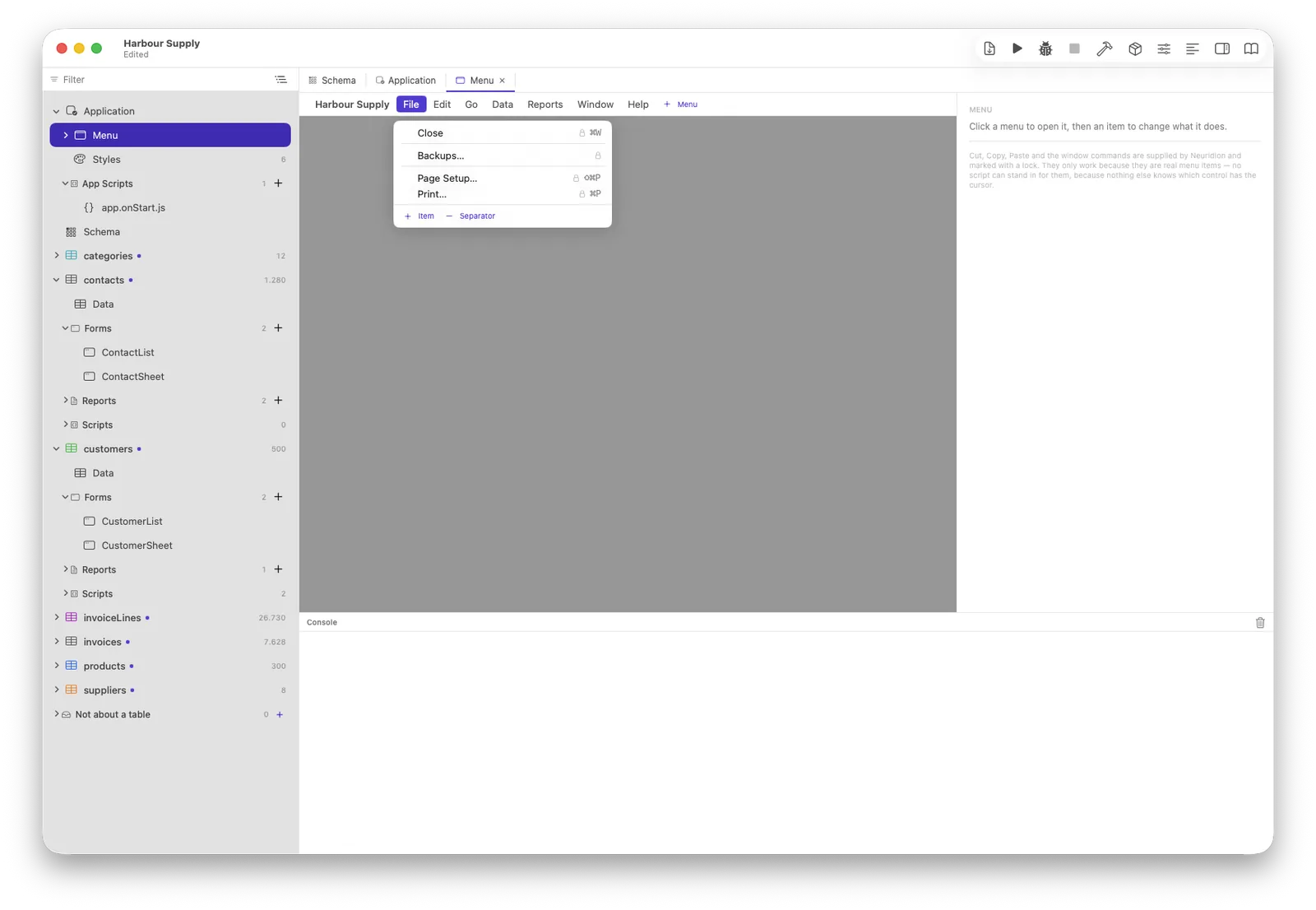
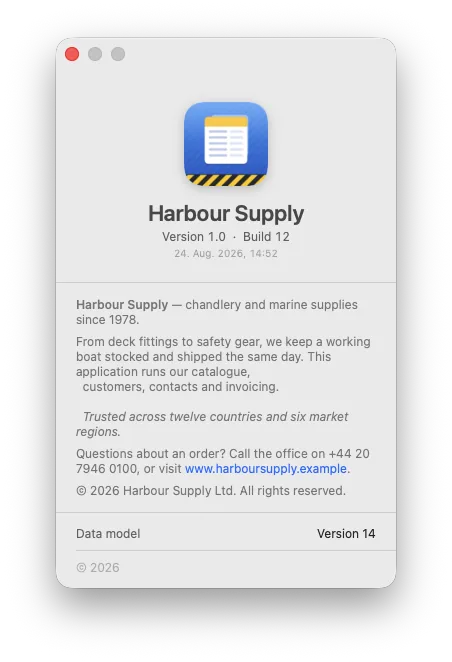
Three things belong to the application rather than to any window, and all three are edited before the build. The menu is yours: the items Neuridion supplies (Cut, Copy, Paste, the window commands) carry a padlock, because nothing else knows which control has the cursor — everything beside them runs a script of yours. The About window takes free text with bold, italic and working links. The icon is one picture; the Client and Server products get their own well, and every size is generated from what you drop in.
Starting data, stamp, updates
Starting data decides what the application finds on its very first
launch — empty, chosen tables, or everything; an update never touches a
customer's data. The build stamp is an imprint in the About
window: which Neuridion built it, the name on the licence, the last four
characters of the key and a short code derived from it. Read by nothing —
take it out and the application behaves identically; it is there so a question
of provenance has an answer, and it sits inside the sealed payload so the answer
survives somebody editing an Info.plist. The key itself is not in
there, and no part of it is ever consulted while the application runs. And the one sentence that
never changes: nothing you build contains a licence check, phones home,
or expires. What your application asks of its users is your
business, never ours.