 Manual
Manual · The book
Schema & data
Tables, fields, relationships, computed columns — and what money is.
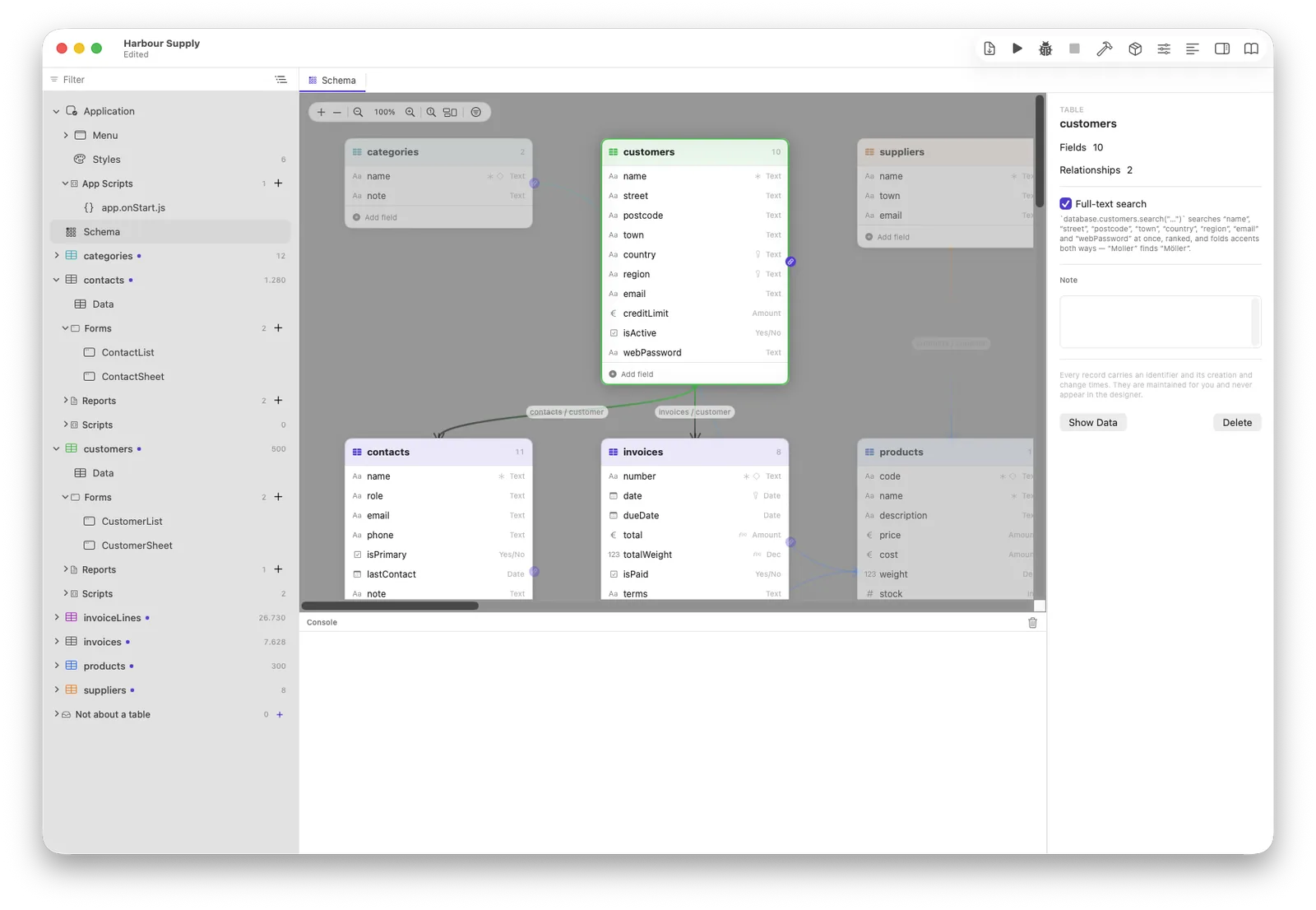
Tables and fields
A table is a card on the canvas; + adds one, and blocks add
several fields in one press (an address is four fields). Double-click a field
for its editor: type, required, unique, indexed, decimals — and a note,
for the colleague who wonders next year. Every table carries four system
fields you never manage: id, createdAt,
modifiedAt and revision, which counts every
effective save and is what multi-user safety leans on.
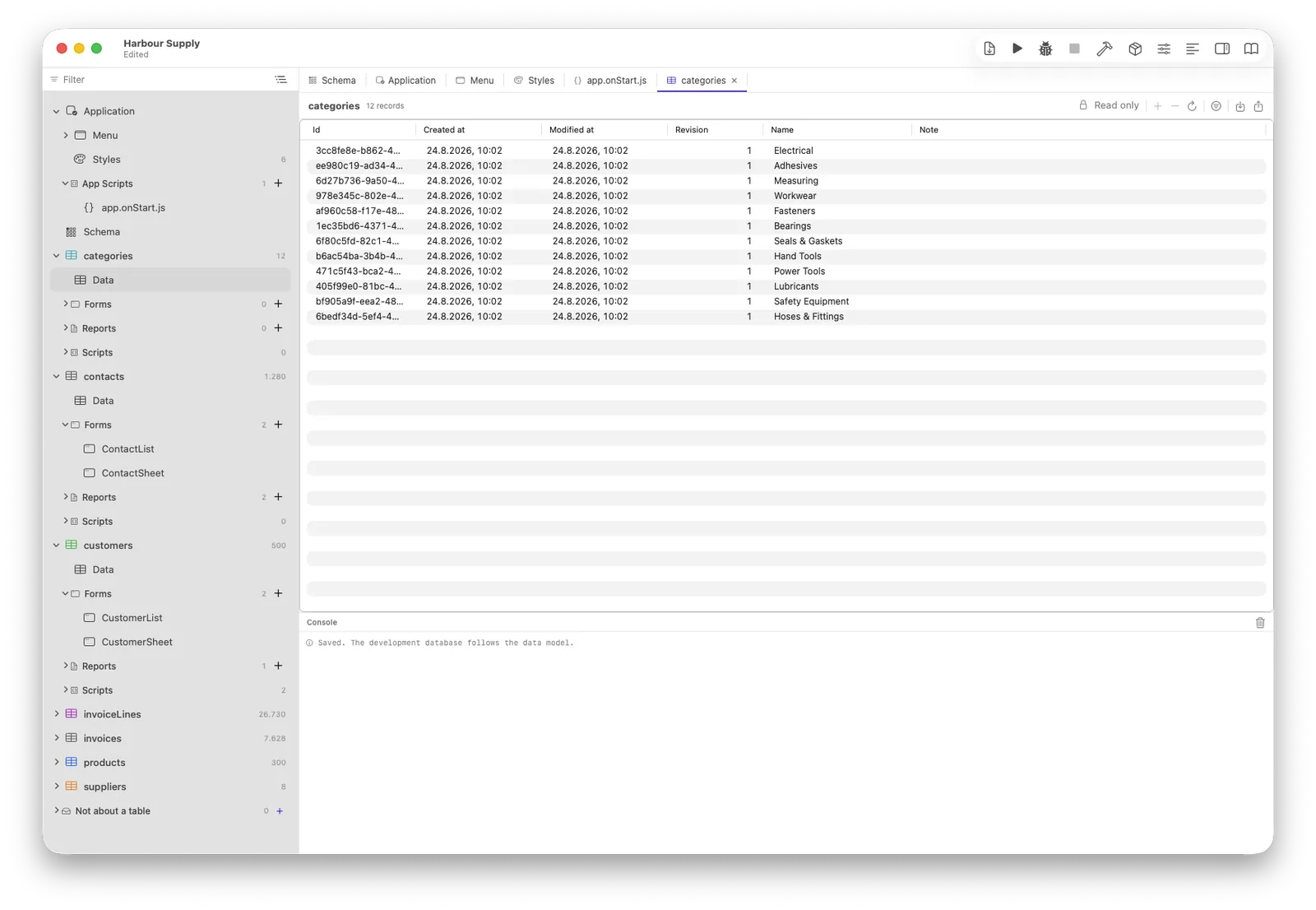
revision that multi-user safety leans
on.Relationships
Drag from one table to another. Neuridion writes the foreign key, and the
relationship reads like a property from both sides:
invoice.customer, customer.invoices. The delete
rule is a decision, not an accident — prevent (the default, the
only one that can never lose data), cascade, or nullify.
Computed fields
A computed field is a real column, filled on the way in — not a
formula evaluated when a window happens to look. invoice.total
as sum of lines.net is stored on every save that touches it, which is
why a list of four thousand invoices shows totals instantly: it reads them,
it does not compute them.
You write the formula in the field editor — as a sentence for aggregates (“the sum of lines.net”) or as an expression — and it is worked out against a real record while you type, so a wrong path shows itself before you save. Children are computed before parents; and changing a formula is a data migration: on the next save of the project every stored value is refilled, oldest dependencies first.
On a form, bind a label to a computed field and it keeps itself current — a script that writes totals into an unbound label goes stale the moment a cell is edited, which is why the examples never do that.
Money
Money is the Amount type: an integer count of minor units — cents — never floating point, so sums are exact to the last cent. An Amount carries its currency wherever it is drawn, form and list alike, with no option to forget it; the field's own scale decides the places (three for a dinar). A plain Number field that should merely look like money has the inspector's show as amount switch.
Files and pictures
Files and images are columns. A stored file keeps its name, kind,
dates and size in the record; the bytes live in a sibling database
(Kundenkartei.files.sqlite) attached to the same connection —
one atomic transaction across both, encrypted together. Lists show
“Vertrag.pdf · 2,4 MB” without touching the bytes; the document is
read the moment somebody actually asks. How big a single file may be is a
project setting (twenty megabytes unless you say otherwise), enforced
at the one funnel every writer passes.
When the schema changes
Save, and the development database follows the model — a safety copy is taken first, columns are added, renamed fields keep their data (identity is matched first, name second), computed fields refill in dependency order. A built application does the same to its customer's database on first launch after an update: an update never touches a customer's data except to migrate it forward, behind a backup.