Running in the beta · ships with 1.0 as Neuridion PRO
Two of you. Twenty of you. One database.
Built, and running: one server holds the data, a client on every desk. Clients find the server over the local network, pair with a six-digit code, and every wire is end-to-end encrypted with pinned keys. Record locking says who is editing what — and lets go the moment they leave the field.
 ServerYour data, your machine
 ClientsDistributed by the server itself
 Single userAvailable today
The server has a face
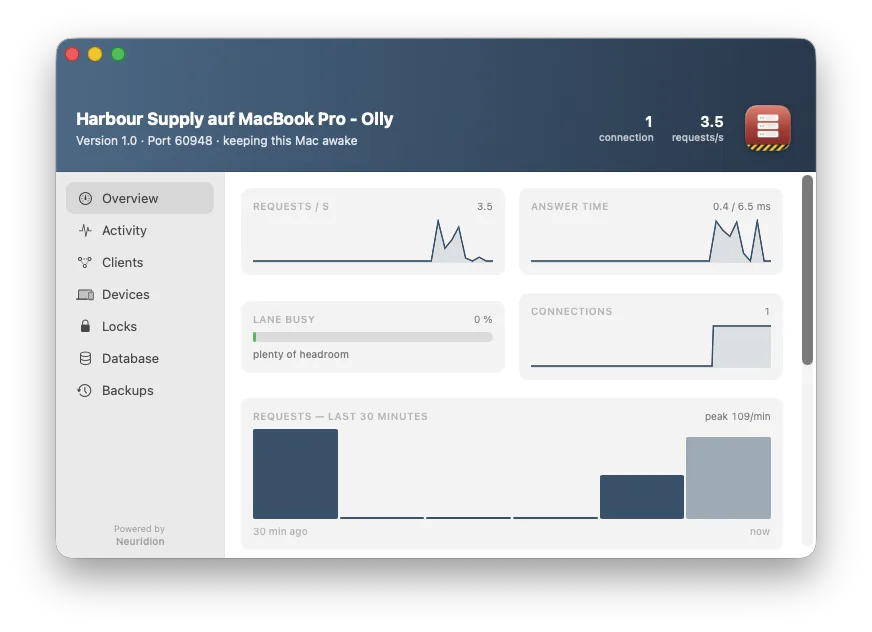
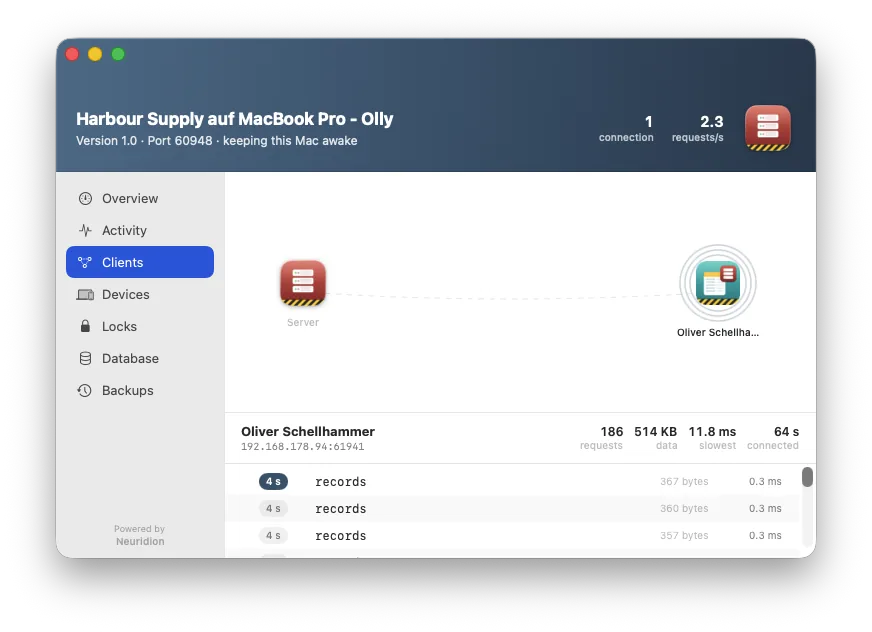
One window answers "is the system well": requests and answer times as curves, the slowest queries by name, backups, locks — and the office as a picture, every desk a node that pulses while it works.
We flooded our own server — the honest numbers
Not a claim, a measurement. One MacBook Air (M2) as the server, a MacBook Pro hammering it over Wi-Fi with real, paired clients at once — each in a tight loop with no pause between requests: lists, counts, a sum, a grouped aggregate, and writes. This is far harsher than any office; it is meant to find the edge, not to describe a normal day.
clients to plan around — more, depending on your app
requests a second at the plateau
connections refused, at any load
| Clients at once | Requests / second | Typical answer | Errors |
|---|---|---|---|
| 1 | 57 | 12 ms | 0 |
| 10 | 370 | 18 ms | 0 |
| 25 | 539 | 34 ms | 0 |
| 50 | 665 | 62 ms | 0 |
| 100 | 712 | 114 ms | 0 |
| 200 | 600 | 262 ms | 0 |
| 400 | 271 | 1.1 s | 0 |
Read the middle of the table, not the end. A safe number to plan around is about 50 clients at once — answers well inside a tenth of a second, throughput climbing to a plateau near 700 a second. How far it really goes depends on what you build and how hard each client works the server — a form that reads one record is not a report that scans a table. Beyond it the plateau holds and then, pushed harder, throughput falls and answers stretch towards a second — the price of the one serial write lane that keeps every rule and every table event in a single honest order. It slows down; it does not fall over. Through 400 clients hammering with no pause at all — far past any real office — not one request failed. Only at around 800 such clients do requests finally begin to time out: the edge, deliberately found.
What the numbers do not show, because it never happened: a refused connection. The path that admits a new client runs on its own, so a busy database no longer turns away someone trying to log in — zero connections were refused at any load in this test. And when a client simply vanishes — a lid closed, Wi-Fi dropped — its connection is noticed and reclaimed on its own, so nothing piles up and an overloaded server settles back by itself once the rush passes, with no restart. The server's own time per request stays in the low single-digit milliseconds; over a LAN the network is the limit long before the machine is.